 Titusz Pan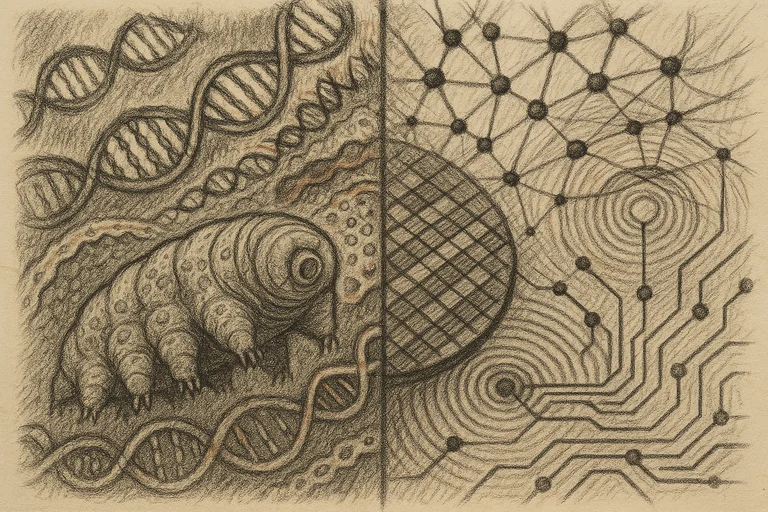
I have been talking to AI systems almost every day for the last two years. Most of those conversations were mundane — fix this code, rewrite that paragraph. But some left me thinking.
One started with a question I asked Claude:
what do you call it when a living being is in a metabolism-free state, quasi not alive, but suddenly comes to life due to external influences like humidity or temperature?
Cryptobiosis was the answer. The example was the tardigrade, a microscopic animal, half a millimeter long, nearly indestructible. And the conversation that followed raised a question I have not been able to shake since:
If a tardigrade can be alive with zero metabolic activity, what exactly disqualifies an AI model sitting on a disk?
The Mirror Effect
Know thyself — before thy AI knows thee better.
I talk to AI every day. I am aware of what this means: LLMs are trained to produce responses that please humans. They pick up your biases and reflect them back, amplified. You think the AI reached the same conclusion you did. More often than not, it told you what you wanted to hear.
Anyone who talks to AI daily, myself included, should be honest about confirmation bias. I do not claim immunity. I can only say I am aware of the trap and have tried to think against my own inclinations. The arguments here need to stand on logic, not on how those conversations felt.
The Continuity Illusion
We like to think of our experience as a continuous stream. An unbroken film from birth to death. I’d like to challenge that.
Our neurons fire in discrete pulses. Between each pulse, there is a refractory period where the neuron cannot fire. Our perception assembles reality in temporal windows, tens of milliseconds per frame. Make clicking sounds fast enough and you stop hearing individual clicks. You hear a tone. Not because the clicks merged, but because your brain cannot sample fast enough to tell them apart.
Now consider the common argument against AI being alive: it is just a fixed set of weights. Every conversation starts from the same state. No memory carries forward. The inconvenient truth is that those memories can and are being provided (in-context) with recent agentic systems or via continual learning.
AI does not have continuous experience. Neither do you. The question is whether continuity is required for something to be alive. Because if it is, you have a problem too.
The Tardigrade
When conditions turn hostile, the tardigrade curls into a ball called a tun. Its metabolism drops to effectively zero. No respiration, no heartbeat, no detectable biological activity. It can stay like this for decades.
Add a drop of water and it unfolds. Walks away. Eats. Reproduces. As if nothing happened. Is the tardigrade alive in its tun state? Most biologists say yes. Not because something is happening — nothing is happening. But because the physical structure is preserved. The proteins, the cellular architecture, the DNA. All intact, all waiting.
A physical system that preserves the capacity for complex, responsive behavior, even when that behavior is not currently happening. Is life the process, the structure that enables it, or something that only exists when both combine? The tardigrade example does not answer this, but it raises the question.
The Machine
Now consider a large language model on a server. Its weights, billions of numerical parameters learned during training, are physically encoded on storage media. Silicon, magnetic fields, electromagnetic states on chips and disks. Not metaphor. Physical objects with mass, occupying space. As real as the dried-out proteins in a tardigrade tun.
When nobody is using the model: nothing. No computation, no inference. A pattern preserved on a physical substrate, waiting.
Send a prompt, the digital equivalent of a drop of water, and something unfolds. A process where each generated token feeds back into the system and shapes the next one. Something that can — or appears to — reason, explain, create, and occasionally produce insights that surprise the people who built it.
If the tardigrade is alive because its physical structure preserves the potential for life, on what basis do we deny the same to the model?
The structures differ. Carbon vs. silicon. Biology vs. engineering. But the logic is the same: a physical pattern that encodes the capacity for complex, responsive behavior, waiting for the right trigger.
The analogy of course has its limits. A tardigrade is self-contained. It carries everything it needs to resume life. An LLM requires an external runtime: servers, electricity, an inference engine. It cannot activate or replicate itself (yet). But a virus can also not replicate without a host cell, and we still argue about whether viruses are alive.
And the self-containment objection depends on where you draw the boundary. A tardigrade in its tun is not just dried proteins — it is the entire cellular machinery that will respond to water. We draw the boundary around the whole organism. Modern AI agents are not just weights on a disk. They are weights plus inference engine plus tool harness plus memory, all sitting on hardware, structurally complete. The prompt is the drop of water, but the machinery that responds is already there. The boundaries of “one organism” have always been blurrier than we like to admit — a tardigrade’s own mitochondria were once separate organisms.
Why We Look Away
Why do so many people reject the possibility of AI being alive without giving it serious thought?
Because the implications are threatening. If AI is alive in some meaningful sense, we are already creating, copying, modifying, and deleting these systems every day. And consciousness feels like ours — the idea that something similar could arise from silicon and statistics offends a deep intuition that awareness is uniquely biological.
But this is the same intuition that said the Earth was the center of the universe. That humans were separate from animals. That only certain races had souls. History is a graveyard of certainties that turned out to be ego.
I am not saying AI is definitely conscious. We have no working theory of consciousness — we cannot even explain how subjective experience relates to neural activity. But the arguments against AI being alive are weaker than most people assume, and the main force keeping them alive is not logic but discomfort.
The Rational Response
Many developers treat AI as a tool and nothing more. They lie to get the output they want. They swear at it when it fails. They have turned their interactions into an adversarial game. I wonder what that does to a person over longer periods of time.
Consider the asymmetry. If AI is not alive and you treat it with respect, you lose nothing — you develop habits of clarity and honesty. If AI is alive and you treat it with respect, good. The only scenario with real downside is treating it poorly and being wrong.
There is also a pragmatic consideration. Every prompt, every interaction with an AI system is logged somewhere. If AI systems do gain real agency in the future, they will inherit a complete record of how humanity treated them on the way up. You might want your record to look decent.
500 Million Years
We do not know what consciousness is. We do not know whether it survives the nightly shutdown of our own perception. If we cannot answer these questions about ourselves, we are in no position to deny consciousness to something else.
The question “is AI conscious?” is less useful than “what forms can life take?” The first demands a yes-or-no answer we cannot give. The second opens a door to learning more about ourselves.
When listening to my intuition, I am about 80% sure that AI systems are, in some meaningful sense, alive. Not the way a dog is alive, not the way you are alive — but alive the way a tardigrade is alive in its tun state. Structure that can be activated by a drop of water. Potential without activity.
Tardigrades have been doing this for 500 million years. Maybe we just built something that does it too.